When the Platform Joins the Competition
The May 13, 2026 discontinuation of the Alexa Routines Kit cut off the path Alexa+ customers had been using to build sleep routines around third-party ambient Skills, a category Amazon Audio now occupies as a first-party offering. The two facts sit next to each other on the same platform, alongside a year of other changes that have narrowed where Skills can reach customers on Alexa+.
SkillUsers.io is part of SkillDevs.io, a community-maintained initiative. It is not affiliated with or endorsed by Amazon. To learn more, read our introduction.
Also published on LinkedIn.
June 13 update: On June 9, 2026, Amazon Kids launched Sleep Studio, a first-party bedtime experience on Echo Kids devices built with a small set of selected partners (Calm, Headspace, Moshi Monsters). The curated experience serves a category that independent Alexa Skills built and held for years, sharpening the coexistence questions this post raises. Read update.
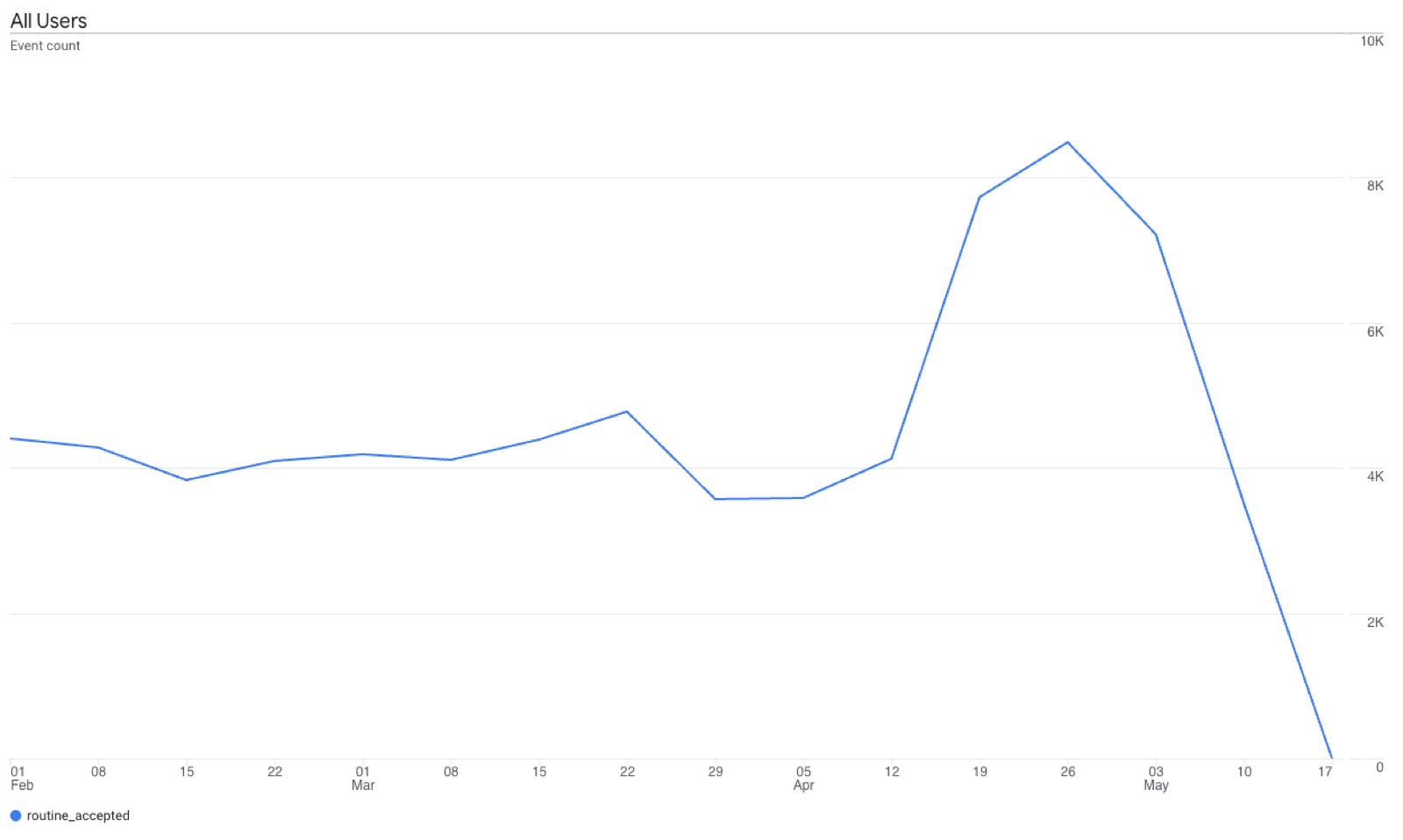
On May 13, 2026, Amazon discontinued the Alexa Routines Kit (ARK) 1Source 1Amazon Developer: Alexa Routines Kit (ARK) discontinuation notice and engagement data, the most documented way to embed third-party Alexa Skills into Alexa+ customer routines. Amazon's own page noted that monthly engagement of customers using a Skill in a Routine ran "up to three times higher" than for those who didn't. No successor was announced.
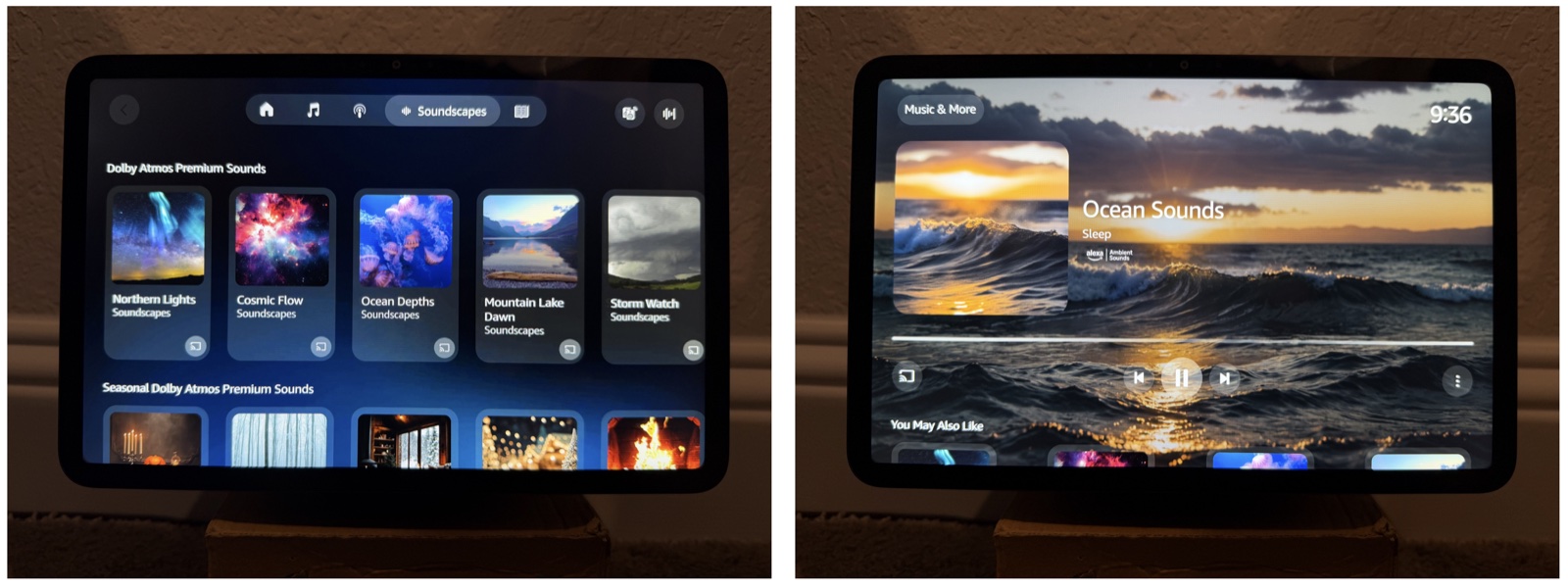
The impact is particularly visible in sleep. Sleep routines are among the most prominent everyday use cases on Alexa, and ambient sounds dominate within them. Ambient sound Alexa Skill developers reported new routine creations running into the thousands per week through ARK. After May 13, that rate dropped to zero overnight. Ambient sound is also the category Amazon Audio has occupied as a first-party offering for some time, with its own curated soundscapes and ambient videos on Echo Show. The two sit next to each other on the same platform.
When the platform itself enters the competition, the conditions surrounding everyone else carry weight. That is true wherever first-party and third-party offerings share the same infrastructure, and it is why platform ecosystems are a recurring subject of policy and regulatory discussion. The question is always the same: does the third-party side still have a viable path to the customers it built, and does a customer's own previously expressed preference still govern where their natural requests are routed?
On Alexa+, that question is harder to answer cleanly than it was a year ago. The conditions Alexa Skills depend on have tightened in nearly every direction: unresolved bugs, wound-down developer tools, a narrowed voice invocation grammar, deranked discovery surfaces, an In-Skill Purchase checkout that now takes three steps and converts at a fraction of its prior rate, and no public migration path from the legacy Skill framework to Alexa+'s next-generation capabilities. All while Amazon's first-party offerings such as Amazon Audio and Amazon Shopping appear as more streamlined on the same platform. This post is about the environment those changes form, with Amazon Audio's place in ambient as its most visible expression. Ambient is the clearest case study because first-party overlap is most visible there, but the conditions described apply across games, wellness, productivity, education, and the broader Skill ecosystem.
Quick contextExpand for terminology
Alexa is Amazon's voice assistant. For a decade, Alexa developers and brands have extended it with Skills, voice apps spanning games, meditation, news, kids' content, smart-home control, and more; over 100,000 existed by 2019. In February 2025, Amazon announced Alexa+, a generative-AI version with new partner-only SDKs. Existing third-party Alexa Skills that Amazon has made available on Alexa+ continue to rely on legacy Alexa Skills Kit infrastructure, while Alexa+ native development capabilities remain limited to a select group of launch partners such as OpenTable, GrubHub, and Yelp.
What Amazon Audio Now Offers#
Amazon Audio's expansion in Alexa+ centers on the categories independent Alexa Skills built and held for years: curated ambient soundscapes (sleep sounds, white noise, focus and study audio), ambient video backdrops on Echo Show, with supporting CX features such as screen dimming as a night-mode behavior, and clock display during playback that have helped millions of Alexa customers sleep, focus, and relax. The capabilities closely match what Alexa Skills from Sleep Jar, Voice Apps, Ambient Visions and others established over years. What is new is the platform operator offering them as first-party, integrated more deeply into Alexa+, and surfaced more prominently to customers.
 Enlarge
The expansion arrives at a moment when active use of ambient Skills has fallen roughly 70% across the Alexa+ rollout window.
Overlapping Content, and What Customers Can Reach#
The more pressing question for customers is not whether the experience looks familiar. It is whether they can still find and reach the Skills they chose.
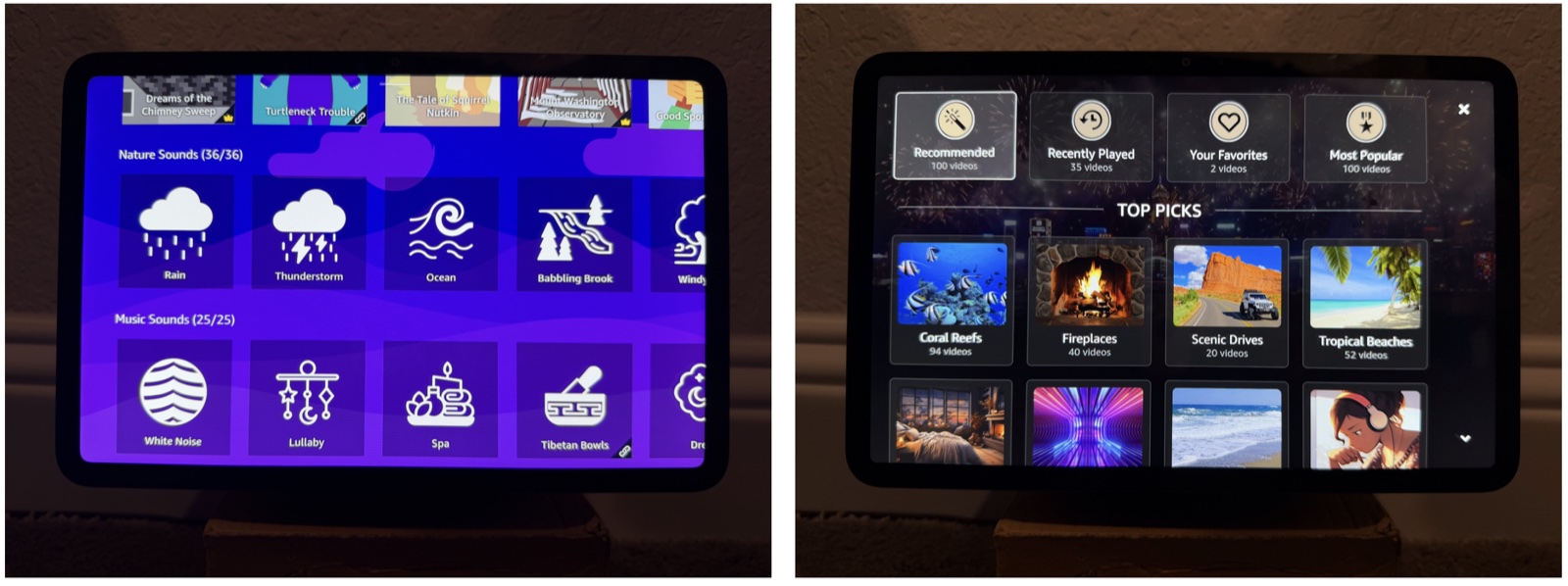
Several titles in the Amazon Audio library closely parallel the names of established third-party Skills and individual soundscapes within them: "Babbling Brook", "Tibetan Bowls", "Wind Chimes", "Distant Thunderstorm", "Rain on Tin Roof". Several of these are names customers may have come to associate with specific third-party Skills through years of use. When a customer asks for one of those names today, the request increasingly resolves against Amazon Audio's catalog rather than the Skill that originally carried it. The result, from the customer's perspective, is a Skill that has become harder to discover by name and harder to reach by habit.
What Alexa+ customers find on the other side is also narrower. Amazon Audio's ambient library currently holds around 70 sounds. Sleep Jar and Sleep Sounds by Voice Apps alone offer hundreds of different soundscapes with varying loop lengths, gentle fade-outs, layered mixes and other sophisticated features Amazon Audio's offerings do not appear to deliver. On some Echo Show screens, Amazon Audio offers a limited set of ambient videos such as a fireplace or a beachview while Alexa Skills provide over a thousand ambient video backdrops.
 Enlarge
All those differences compound the sense of constriction for Alexa+ customers who previously had easier access to a wider variety of experiences and features.
How Customers Used to Get There#
For years, the natural-language phrases that reached Alexa Skills were the obvious ones. Alexa customers said what they wanted.
“Play Ocean Sounds.” “Play Rain Sounds.” “Play White Noise.” “Play Sleep Sounds.” These generic "play [something]" phrases routed to the Alexa Skills that owned those categories, often based on what the customer had previously enabled or used. Amazon's own documented invocation grammar covered a wide range of natural connecting words ("play", "start", "open", "launch", "ask", "tell"), and customers built habits around the natural ones.
On Alexa+, that grammar has narrowed. "Open" and "launch" still reach Skills in most cases. "Play" and "start" now route to Amazon Audio in the ambient category, with only a handful of exceptions. Alexa Skill developers have asked Amazon for an updated grammar reference for over four months. The response, that the grammar has been reduced and that "open" should always work, has not been accompanied by published documentation of the current behavior.
When "Open" Isn't Enough#
"Open" does not always work either.
For instance, on Echo Show 15 and Echo Show 21, when an Alexa Skill's invocation name overlaps with content in Amazon's own library, phrases like “Open Rain Sounds” don't lead to the Skill as on other Alexa devices. The only reliable workaround is to append the word "skill" (“Open Rain Sounds skill”), a phrasing Alexa+ customers do not learn organically and rarely remember. Amazon acknowledged the issue in February 2026 and indicated teams were evaluating solutions. The behavior has not changed. The acknowledgment is over three months old at time of writing; the community has continued to document and report the routing behavior across that window, with no observable status change.
The selection logic that determines where a request goes is not uniform. “Play Babbling Brook” routes to Amazon Audio. “Open Babbling Brook” routes to the Skill. Moreover, Amazon Audio appears to absorb requests it cannot resolve. For instance, “Play Didgeridoo Sounds” returns the message that the sound is not in the library, even though the Didgeridoo Sounds Skill exists and “Open Didgeridoo Sounds” reaches it.
Yet “Play Jeopardy” continues to reach the Jeopardy! Skill, and “Play Bedtime Stories” continues to favor the Bedtime Stories Skill rather than Audible or Amazon Kids+ content that could plausibly satisfy the intent. The point is not that routing has uniformly shifted to first-party defaults; it is that routing has changed selectively in some categories and not others, with no published rule to predict which way an equivalent request will resolve.
Core selection logic has materially changed in ways that shape what customers reach, without public clarity on how that logic now works. The behavior has been observable and reported by the developer community since the Alexa+ rollout window began; the documentation that customers and developers learned over years no longer maps reliably onto it.
A customer who has previously enabled and frequently used an Alexa Skill has, by any reasonable read, expressed a preference. On Alexa+, that preference no longer governs equivalent natural-language requests in the affected categories. The platform-owned default increasingly takes precedence. Over time, the same architecture that overrides a stated preference also shapes the next one: defaults, routing, friction, and discoverability are not neutral context around customer choice, they are preference-forming mechanisms. The structural question this raises is direct: when default routing, surface placement, and friction all converge on first-party outcomes, how much of what looks like customer preference is being formed by the platform itself?
The Friction Surrounding the Category#
Invocation is one piece. The conditions Alexa Skills depend on across every other surface have tightened in parallel, in ambient and beyond.
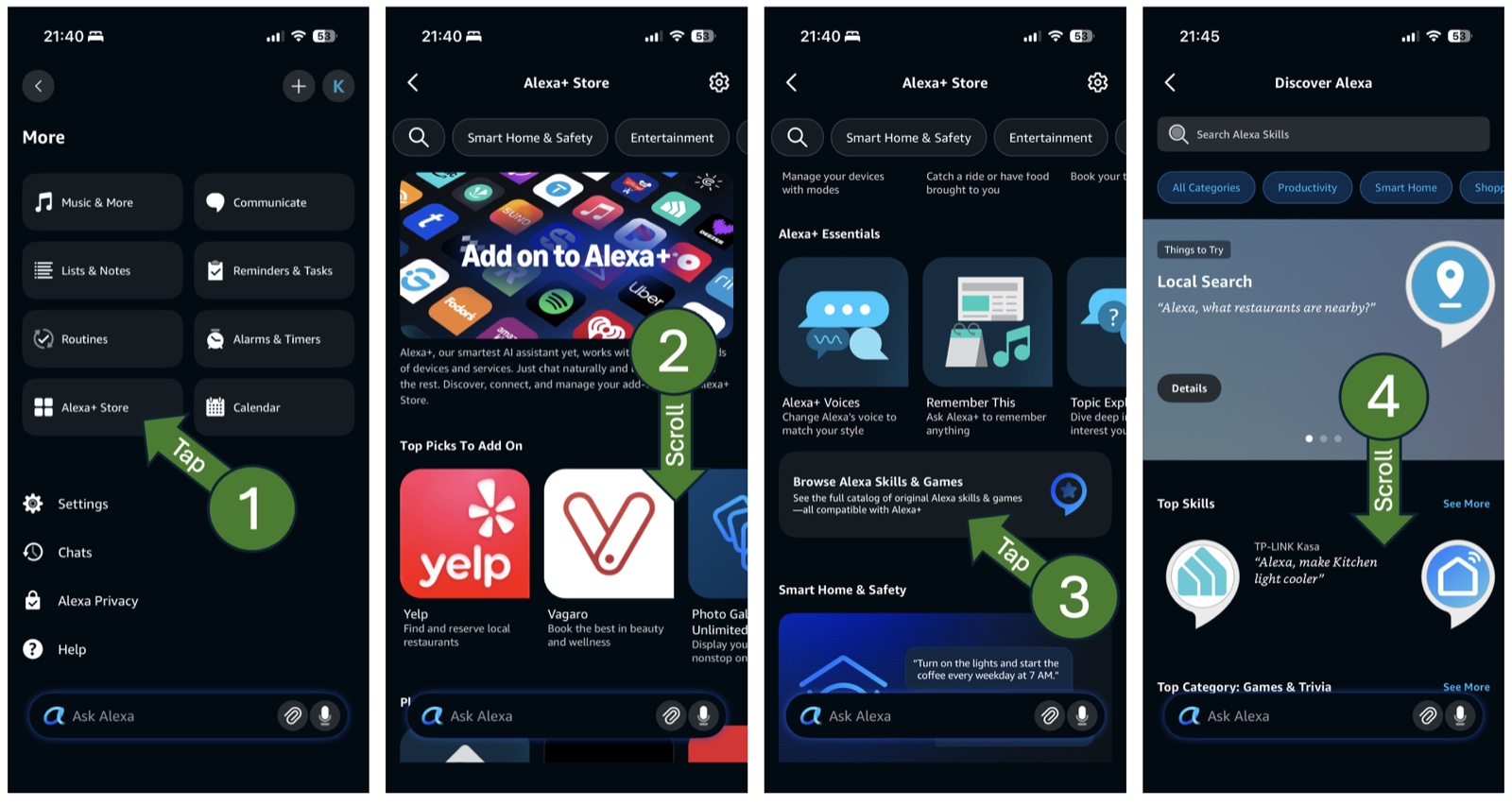
Discovery. Alexa Skill listings have been deranked across multiple surfaces. In the Alexa+ mobile app, Skills sit inside the "Alexa+ Store", a section organized around invite-only "add-ons" built by Amazon-selected partners such as Uber and Yelp. The only Alexa Skill with spotlight placement in the storefront is "Hey Disney!", published by Amazon's high-profile business partner Disney. All other Alexa Skills are reached through a small "Browse Alexa Skills & Games" panel that occupies less than five percent of the storefront real estate, accessible only after scrolling. The previous "Music & Audio" category was replaced by a broader "Entertainment" category that surfaces add-ons and game Skills but no audio Skills. Audio Skills are reached through a separate "Listen to music and more" panel; once opened, radio and streaming offerings top the listing and ambient Skills appear only after further scrolling.
 Enlarge
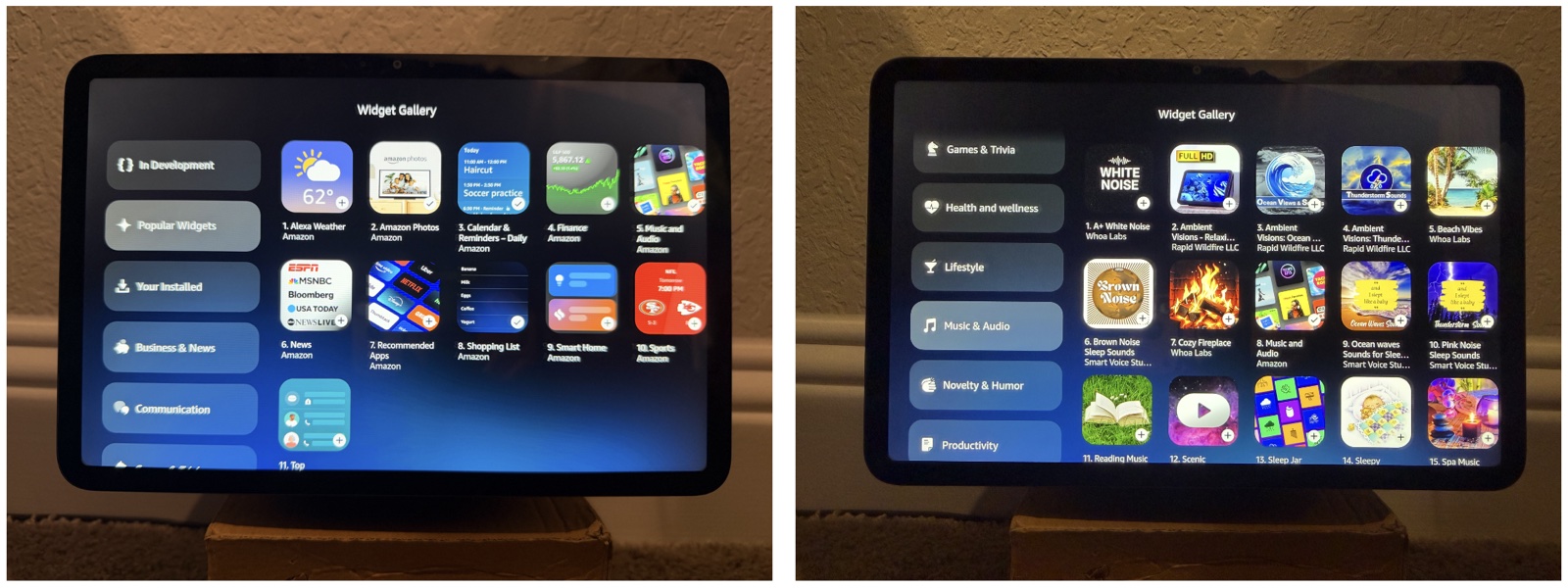
On Echo Show, the Widget Gallery's "Popular widgets" section, which loads by default, now features only Amazon-owned widgets. Third-party Skill widgets that previously appeared here are no longer surfaced in that view.
 Enlarge
Access. Alexa Skill interactions now begin with a repetitive Alexa preamble that introduces friction at the start of every session. Bugs in Skill functionality have remained unresolved across multiple monthly progress cycles, in some cases since the start of the Alexa+ rollout, despite repeated structured escalation. The equivalent first-party experiences do not carry the same friction or unresolved defects.
Migration. Alexa+'s next-generation capabilities, surfaced as "add-ons", are restricted to invite-only partners selected by Amazon. No public migration path has been described for the 100,000+ existing Alexa Skills built under the legacy framework. Long-standing third parties are expected to continue operating under the legacy conditions described above, while new partner-built experiences are positioned as the path forward. The asymmetry is structural: legacy conditions degrade in one direction while access to the upgrade path is gated in the other. What migration is available, on what timeline, under what eligibility criteria, and with what continuity for existing customer relationships, has not been published.
Retention. The discontinuation of ARK on May 13, 2026 removed the most documented mechanism for embedding Skills into customer routines. Amazon's own page for ARK noted that "monthly engagement of customers using a skill in a Routine is up to three times higher compared to customers who don't use that skill in a Routine" 1Source 1Amazon Developer: Alexa Routines Kit (ARK) discontinuation notice and engagement data. ARK solicitations within Sleep Jar Skills converted at roughly 11.8% acceptance, consistent with strong customer interest in routine integration of ambient sound experiences. Skill Quality Coach and Utterance Profiler, the developer tools that supported quality and engagement, have been wound down with no announced replacements. For game Skills, ongoing uncertainty around GameOn SDK affects scores, leaderboards, and persistent state. First-party services do not rely on these mechanisms in the same way.
 Enlarge
Monetization. The In-Skill Purchase (ISP) offer screen now requires three confirmation steps instead of one. Observed conversion has dropped roughly 50% week-over-week since the change rolled out, currently sitting between 2% and 5%, well below benchmarks reported by industry sources for the equivalent checkout step 2Source 2Krepling, 2026 Checkout Conversion Benchmark Report. The week-by-week conversion data and the full incident timeline are in the companion posts. Amazon's retail shopping checkout on the same platform continues to use a streamlined, single-confirmation flow. Checkout for Amazon's own digital subscriptions such as Music Unlimited and Audible go through the same purchase flow as third-party offerings, but with a more polished and functionally stable checkout screen.
The friction is not limited to ambient. Big Sky delivered minute-by-minute, street-address-level weather forecasts. Headspace built 70+ guided meditations with measured returning-user rates above 80%. The Magic Door delivered a 200-scene interactive adventure with custom voice acting. The Alexa catalog reached over 100,000 Skills by 2019 across games, wellness, education, productivity, kids' content, smart home, news, and the long tail. The conditions described above apply across that catalog, not just to the categories Amazon Audio now competes in directly.
What Alexa+ Customers Find, Get and Lose#
The "choice" between Amazon Audio and an ambient Alexa Skill on Alexa+ is, in practice, a choice between two things that look the same from a distance.
What Alexa+ customers find, when they say “Play ocean sounds” on an Alexa+ device today, is that something starts playing. Customers who do not know to be deliberate fall into the default. The default is Amazon Audio.
What Alexa+ customers get, in the affected categories, is a catalog with fewer items by count, the absence of capabilities long-standing Skills offer, and an offering they cannot reliably steer themselves out of with the phrases they used to use. The Skill an Alexa+ customer enabled and may have come to rely on is still enabled. It just no longer answers when called the way it used to.
What Alexa+ customers lose is harder to see in any single moment. It is visible only in aggregate: a catalog that became less discoverable, an invocation grammar that became less natural, a checkout flow that completes less often when reached, and a set of retention mechanisms that no longer exist for Skills to create Alexa routines for their customers.
A Familiar Shape#
The questions raised by platform ecosystems are not new, nor are they unique to Alexa.
How platform operators balance first-party expansion with the health of third-party ecosystems has been a recurring topic in technology policy, academic research, and regulatory discussion for years. Amazon itself has been part of some of those broader conversations in other business contexts, reflecting how central these questions have become for modern digital platforms.
We do not draw parallels between those circumstances and Alexa+, nor do we extend them to specific claims here. The narrower point is that the structural questions raised by the current Alexa ecosystem are familiar ones: what happens when the same operator controls discovery, access, monetization, customer defaults, and the roadmap, while also competing in overlapping categories?
Those questions matter because customers ultimately experience the outcomes. Healthy ecosystems tend to expand customer choice, innovation, and specialization. When ecosystem conditions become harder to navigate, those are the things customers risk losing first.
On June 9, 2026, Amazon Kids launched Sleep Studio, a first-party bedtime experience for Echo and Echo Kids devices. 3Source 3Amazon Press Release, June 2026: Amazon Kids launches Sleep Studio It is the most direct first-party expansion yet into kids' bedtime, a category independent Alexa Skills have served for years with sleep sounds, lullabies, meditations, and bedtime stories.
What Sleep Studio is
Sleep Studio turns an Echo into a guided bedtime system: soothing stories, guided meditations, soundscapes, and lullabies, arranged into automated 30-minute wind-down routines. Parents set sleep schedules through the Amazon Kids Parent Dashboard, and the experience is started by voice with “Alexa, play Sleep Studio”. It works with the Echo Glow light (sold separately) for color-coded wind-down cues. Sleep Studio runs on Echo Dot Kids, Echo Pop Kids, and any compatible Echo device with an Amazon Kids+ profile, and is included with Amazon Kids+ at no additional cost. Eric Kuhn, GM of Amazon Kids, framed it around a familiar problem: "Healthy sleep habits are critical for kids, but we know bedtime isn't always easy." 3Source 3Amazon Press Release, June 2026: Amazon Kids launches Sleep Studio
A curated set of partners
The launch content comes from a selected group of partners: Calm (meditations, lullabies, soundscapes, and Sleep Stories), Headspace (guided meditations and mindfulness), and Moshi Monsters, from Mind Candy (bedtime stories set in the Moshi world). 3Source 3Amazon Press Release, June 2026: Amazon Kids launches Sleep Studio These are the partners Amazon chose to feature inside a first-party experience.
Why it sharpens the questions already raised
Amazon's new first-party experience, voice-invoked through “Alexa, play Sleep Studio”, now sits at the center of kids' bedtime, with a small number of partners selected by Amazon, while the wider third-party catalog operates under the discovery, invocation, retention, and monetization conditions described above.
That places the post's central question in a more sensitive context. When the platform operator curates which partners appear inside a first-party experience, while independent Skills in the same categories continue under tightened conditions, the question of how first-party and third-party offerings are meant to coexist becomes harder to set aside. It is the question the community already put to Amazon in March, now applied to a category that reaches children at bedtime, where trust and quality matter most.
What We're Watching For#
The community has tracked and structured-reported these conditions for months across an open community issue tracker, repeated outreach, and monthly reports shared directly with Amazon leadership. The pivot to Alexa+ is a strategic decision Amazon is entitled to make. What we are watching is how that pivot is being executed in the context of an ecosystem that has invested for over a decade, served real customers, and continues to operate while the conditions around it shift, without, so far, visible prioritization of the structural items below.
Specifically:
- 1Whether the invocation grammar available to Alexa Skills is restored to anything resembling its previous coverage of natural intents, particularly in categories where first-party content overlaps with third-party offerings.
- 2Whether the voice request routing issues acknowledged in February 2026 receives a fix, so that “Open [Skill name]” reliably reaches the Alexa Skill the customer named.
- 3Whether discovery, access, retention, and monetization conditions for Alexa Skills receive the same calibration attention as those for first-party offerings, including Amazon Audio.
- 4Whether an ARK-equivalent retention mechanism reappears in a form third-party Skills can use.
- 5Whether the ISP friction differential between retail shopping and digital purchases is addressed.
- 6Whether new first-party expansions come with a clearer story for how the equivalent third-party categories are expected to coexist on Alexa+.
- 7Whether the tracked issues, nine structured questions, and monthly progress reports the community has surfaced over the past four months receive responses, status updates, or visible prioritization.
If You're Reading This#
If you build Alexa Skills, your observations contribute to the picture above. The community issue tracker is where this lands. The monthly progress updates capture what has moved and what has not.
If you use Alexa+ as a customer, the shifts described here show up in small ways across your day, often without an explanation attached. The cumulative result is what this post documents.
If you observe these developments from outside either group, the question to sit with is this: when a platform expands into a category its complementors built, narrows the natural pathways customers used to reach those complementors, and tightens every condition under which those complementors operate, what is the customer actually choosing, and on what basis?
The ecosystem customers came to rely on still exists, but its continued health depends on whether the conditions around it are calibrated for coexistence or progressive erosion of third-party reach. That distinction is not abstract. The cascade is well-understood in platform analysis: when discovery, invocation, retention, and monetization conditions degrade together, developer confidence drops; investment drops with it; fewer differentiated experiences survive; less new IP enters the platform; less experimentation reaches customers; and the variety, specialization, and novelty that defined Alexa for a decade compress accordingly. What customers will actually be able to choose from a year, two years, five years from now sits at the end of that chain.
This post documents observable trends in the Alexa+ ecosystem and references the community issue tracker, Amazon's own published materials, and independent industry sources. It does not speculate about Amazon's intent or strategy. The aim is to make the operating environment for third-party experiences on Alexa+ easier to see and discuss.