A Signal of a Larger Pattern in the Alexa Ecosystem
Third-party purchase conversion on Alexa has collapsed into single digits, while retail shopping on the same platform continues to operate seamlessly. Discoverability, retention, and performance issues sit alongside it. Four questions worth sitting with about the health of the Alexa developer ecosystem, and what it means for the Alexa customers who still rely on it.
SkillUsers.io is part of SkillDevs.io, a community-maintained initiative. It is not affiliated with or endorsed by Amazon. To learn more, read our introduction.
Also published on LinkedIn.
The picture for those who build on Alexa has gotten difficult to read in one direction. Alexa developers and brands report ongoing issues across four areas of the platform, tracked in the community issue tracker. These are not separate threads. They share a direction of travel, and they affect everyone who builds for Alexa: independent developers, startups, and established brands across B2C and enterprise, media, entertainment, news, games, and wellness.
Discoverability has narrowed in Alexa+, with Alexa Skills surfaced less prominently than before. Retention has weakened, with fewer users returning to Skills after recent platform changes. Performance and reliability gaps have appeared in journeys that previously worked. Monetization is where the strain shows most clearly in the data: conversion on the in-skill purchases (ISP) checkout has dropped to the 2 to 5% range, a level at which monetization on the platform is no longer practical for most Alexa developers.
Quick contextExpand for terminology
Alexa is Amazon's voice assistant. For a decade, Alexa developers and brands have extended it with Skills, voice apps spanning games, meditation, news, kids' content, smart-home control, and more; over 100,000 existed by 2019. In February 2025, Amazon announced Alexa+, a generative-AI version with new partner-only SDKs. Existing third-party Alexa Skills that Amazon has made available on Alexa+ continue to rely on legacy Alexa Skills Kit infrastructure, while Alexa+ native development capabilities remain limited to a select group of launch partners such as OpenTable, GrubHub, and Yelp.
Most paid Skills monetize through in-skill purchases (ISP), a checkout flow operated by Amazon: the ISP offer screen on devices with a display, or a voice-only prompt on headless devices like the Echo Dot. Amazon's own first-party services on Alexa (Music, Audible, Kids+, Shopping) do not run through ISP, and use Amazon's own checkout systems separately.
Not long ago, Alexa Skills were a heavily supported and publicly championed part of the platform: developer rewards, subsidized hosting, dedicated tooling, and a steady cadence of communication. That posture has changed. The pivot to Alexa+ is a strategic decision Amazon is entitled to make. What stands out is less the pivot itself than how it is being executed, with new friction layered onto third-party experiences and Alexa+ customers while Amazon-owned experiences appear to remain streamlined, with developer support and tooling reduced or discontinued ahead of clear replacements (most recent announcements for these include Alexa Routines Kit, Skill Quality Coach, and Utterance Profiler), and limited public clarity on the path forward. The pattern reaches beyond Alexa Skills, and speaks to how a large platform carries an ecosystem and its customers through a strategic shift.
These questions are raised in that spirit:
- 1How attractive and reliable is the Alexa+ platform as a long-term environment for building and maintaining third-party experiences?
- 2How consistently are core platform capabilities and user experiences applied across different types of offerings?
- 3What level of support and engagement can Alexa developers expect as Alexa+ evolves?
- 4What does the path forward look like for the existing base of Alexa Skills that Alexa+ customers continue to use?
What follows examines each in turn, drawing on observable signals. Prefer to fast-forward? Jump to suggested answers based on observations →
A Familiar Pattern, Unevenly Applied#
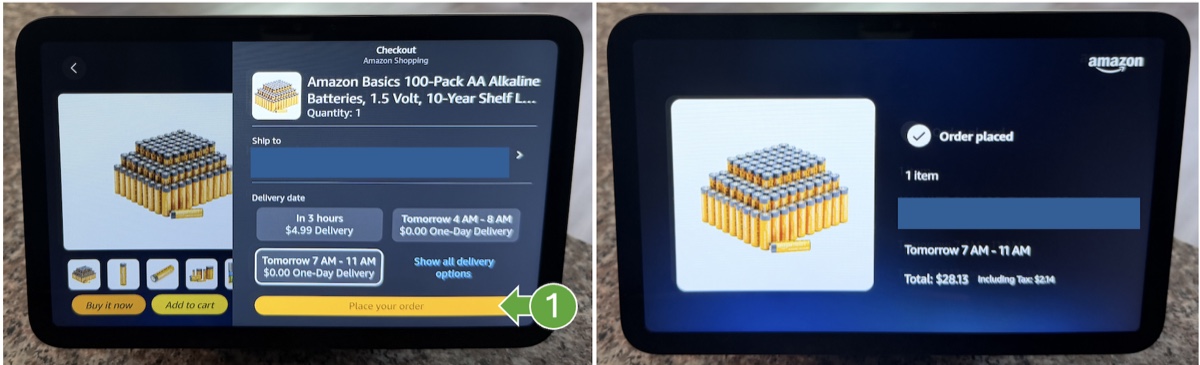
The irony is hard to miss. The third-party checkout for Alexa Skills in Alexa+ that has just become harder, slower, and more error-prone runs on a platform built by the same company that invented and patented 1-Click in 1999 1Source 1Amazon Press Release, October 1999: Amazon.com Receives Patent for 1-Click and spent a quarter century making frictionless checkout the e-commerce default. The pattern of "minimize friction at the moment of purchase" is familiar. It just appears to be applied unevenly: Amazon's retail shopping flow on Alexa continues to operate with lower friction than what third-party Alexa Skills now go through.
The differences are not only procedural. The third-party checkout carries usability constraints and functional limitations that Amazon's retail checkout on Alexa+ does not, including the requirement to use the account's default payment method, with no in-flow option to choose another. The unevenness shows up in process, in design, and in capability.
Communication and Prioritization#
Issues affecting revenue-critical surfaces have been raised through Amazon's official channels and acknowledged. Resolutions have not followed at a pace that matches the impact: the original ISP offer screen issues were filed in early January and acknowledged shortly after, with no observed resolution four months on. The Alexa developer community shared a structured set of nine questions with Amazon on March 2, 2026, covering functional stability, communication of changes, and the path forward for existing Alexa Skills. To date, we have not received responses. From outside, the apparent prioritization of the issues that affect Alexa developers most directly is unclear. To keep a steady cadence on our side, the community now publishes monthly progress updates, shared with Amazon and posted publicly here.
Reading the Numbers#
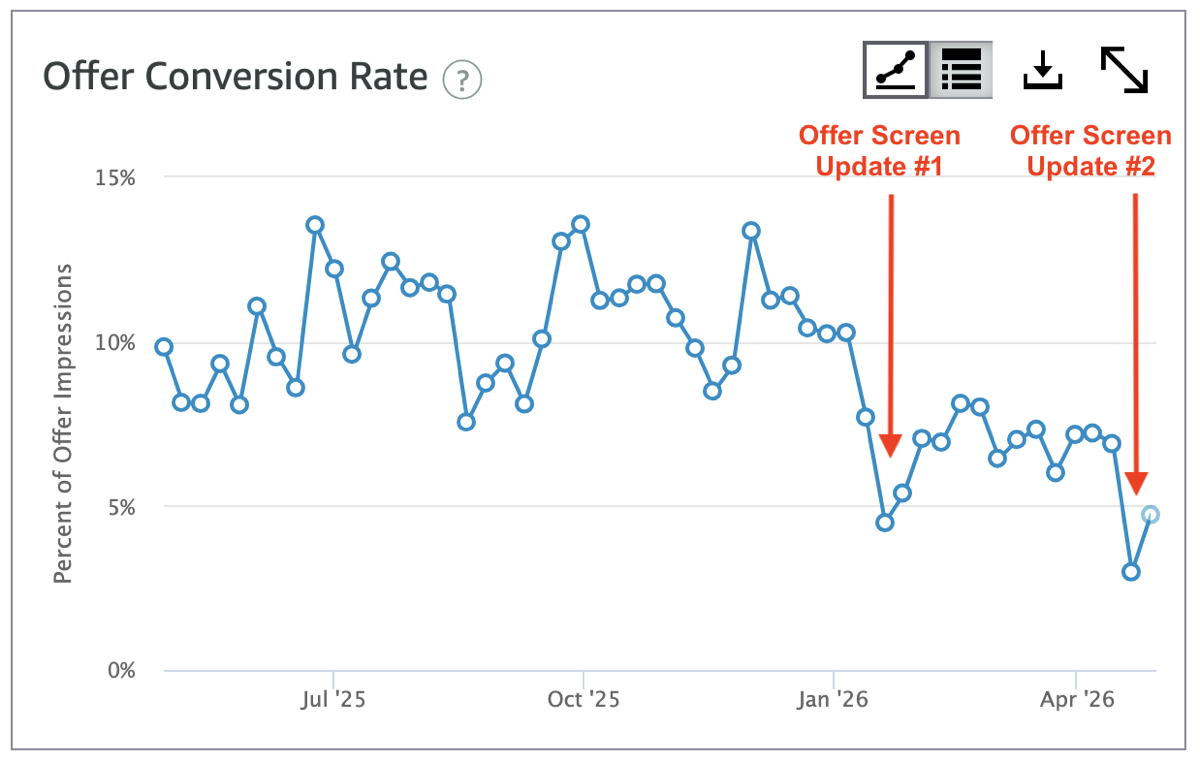
Conversion rates on the ISP offer screen have dropped into the 2 to 5% range across affected Alexa Skills since the latest changes 4Source 4SkillDevs.io: When the Checkout Breaks (April 26 update). For any digital product that monetizes through purchases on Alexa+, that level of conversion is not sustainable. A funnel that converts at single digits at the point of intent calls into question whether monetization on the Alexa+ platform works at all.
 Enlarge
Industry benchmarks help frame how unusual that level is. The Krepling 2026 Checkout Conversion Benchmark Report places the average completion rate at the equivalent checkout step at 47.1% across industries, with standard checkouts averaging 41.3% and express methods (Apple Pay, Shop Pay, Google Pay) reaching 63 to 71% 5Source 5Krepling, 2026 Checkout Conversion Benchmark Report. Two to five percent puts the ISP offer screen roughly an order of magnitude below the industry baseline for the same step.
What the Checkout Reveals#
The companion post on the ISP offer screen issues has the full timeline, charts, and observations. The short version: regressions started on Echo Show in early January and dropped conversion rates by roughly half. In late April, additional confirmation steps were added to the purchase flow across all Alexa+ devices in US. Accepted rates fell more than 50% week over week. Fewer than 20% of users who entered the offer screen made it back into the Alexa Skill.
Industry research is consistent on what extra steps cost. Baymard Institute reports an average cart abandonment rate of 70.19%, with roughly one in five abandonments attributable specifically to checkout being too complicated or too long 6Source 6Baymard Institute, E-Commerce Cart & Checkout Usability Research. Multi-step flows correlate with abandonment in the 50 to 70% range; one-click flows bring it to 20 to 40% 7Source 7Frisbii, Best Practices to Increase Checkout Conversion Rates.
 Enlarge
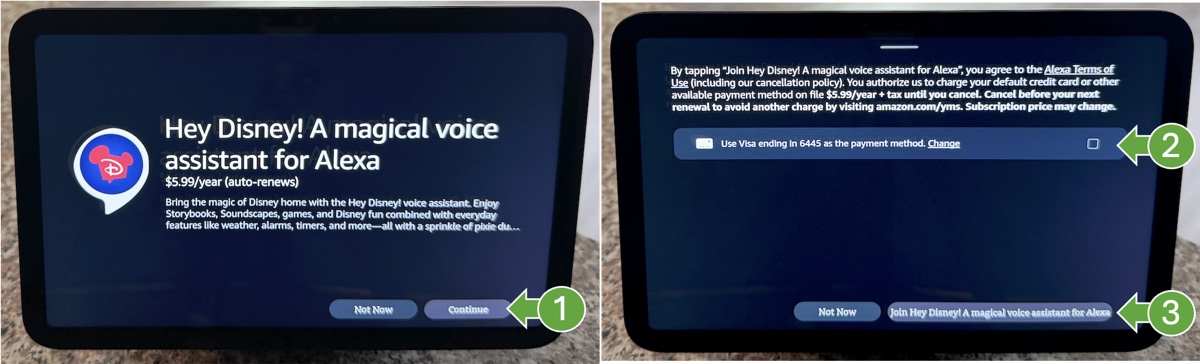
The design pattern reinforces what the data shows. The accept button on a Hey Disney! offer reads "Join Hey Disney! A magical voice assistant for Alexa" 8Source 8Amazon Skill Listing: Hey Disney! A magical voice assistant for Alexa, product-page copy embedded in a CTA where standard checkout convention calls for short, action-oriented labels (Buy, Subscribe, Continue). Similar issues repeat across the screen: buttons that aren't voice-activated on a voice-first device, missing product details and developer prompts, blurred Alexa Skill logos, absent customer ratings. All are documented in the issue tracker. Any conversion-optimized checkout would have caught them early.
 Enlarge
One observation worth flagging: the same multi-step confirmation that now sits in front of Alexa Skill purchases also appears in front of purchases for Amazon's own digital services on Alexa+, such as Photos and Audible. Retail shopping is the exception. That digital purchases on both sides of the platform share the same friction raises a question worth asking: how serious of a play is Alexa+ monetization, for anyone?
A Pattern That Predates the Checkout#
The ISP checkout is the most visible signal because the data is unambiguous. The broader trend has been building for years.
The rate of new Alexa Skills launched in the U.S. fell 38% from 2018 to 2019, and continued to decline 9Source 9Voicebot.ai, January 2020: New Alexa Skill Data. In April 2024, Amazon ended the Alexa Developer Rewards Program and discontinued AWS Promotional Credits for Alexa, which had subsidized hosting costs for many independent developers 10Source 10Bloomberg, April 2024: Amazon to Stop Paying Developers to Create Apps for Alexa,11Source 11Hackaday, April 2024: The Future Looks Bleak for Alexa Skill Development. Roughly a year later, the Amazon Appstore for Android was wound down, with new app submissions ending in February 2025 and the platform shutting down on August 20, 2025 12Source 12Engadget, February 2025: Amazon Is Shutting Down Its Third-Party Android App Store,13Source 13Android Authority, February 2025: Amazon Is Shutting Down Its Appstore for Android Devices. The Alexa+ SDKs that followed are partner-only at launch, with no published timeline for broader access 3Source 3Amazon Developer Blog, February 2025: Introducing AI-native SDKs for Alexa+. Most recently, Amazon announced that the Alexa Routines Kit (ARK), the integration that allows Alexa+ customers to build their Alexa routines around Alexa Skills, will be discontinued on May 13, 2026 with no replacement announced. Amazon's own page for ARK acknowledges that "monthly engagement of customers using a skill in a Routine is up to three times higher compared to customers who don't use that skill in a Routine" 15Source 15Amazon Developer: Alexa Routines Kit (ARK) — discontinuation notice and engagement data.
None of these changes is identical to the others. Each has its own context. What they share is the direction of travel.
Active Use Is Trending Down#
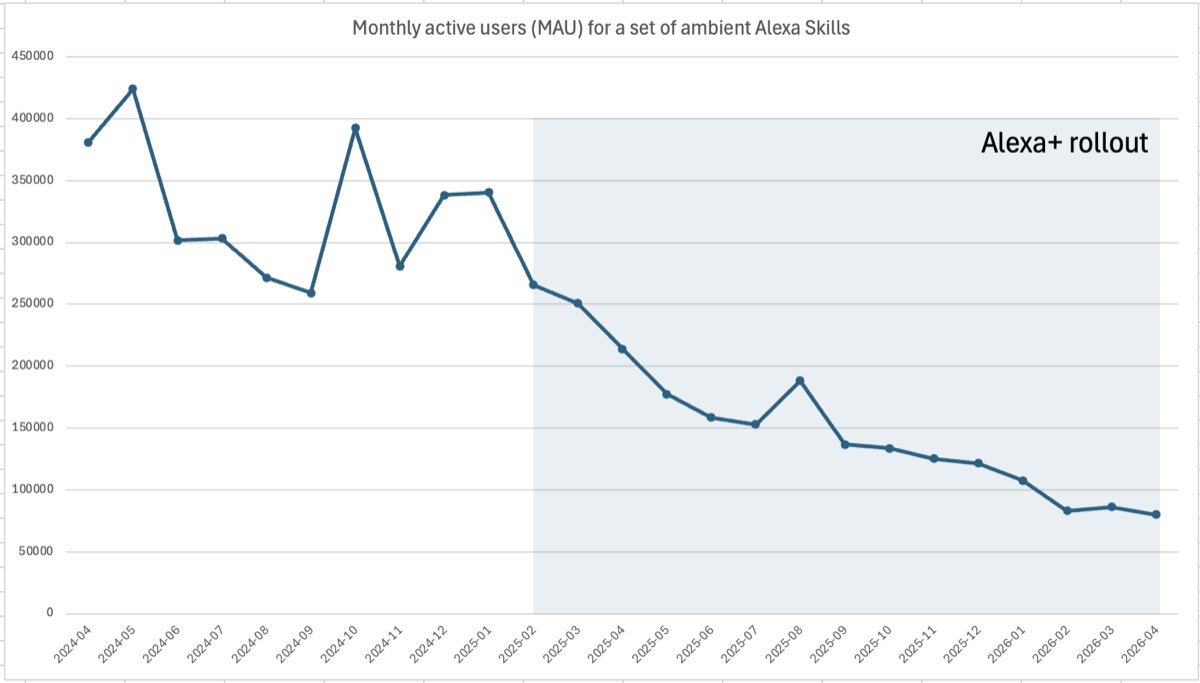
The trend extends beyond monetization. The chart below shows monthly active users for the Ambient Visions series of Alexa Skills, one example portfolio in the ambient category. Similar trends have been observed by developers of more popular Alexa Skills in Alexa+, suggesting the pattern is systemic.
 Enlarge
Through 2024, MAU sat within a stable band. Since the Alexa+ rollout began in early 2025, it has fallen by roughly 70%, with the steepest segment in the second half of 2025. The shape, a sustained, compounding decline that tracks the rollout window closely, points to friction in discovery and retention layered on top of the monetization friction documented above. The Alexa customers who used these third-party experiences regularly are using them less.
This seems to sit in contrast to how the rollout has been characterized publicly. In his 2025 letter to shareholders, Amazon CEO Andy Jassy wrote:
"The team had to make these changes [Alexa+ rollout] while also serving the existing large customer base, and execute a roll out that didn't break all the functionality on which so many Alexa customers have come to rely. It's been worth it." 14Source 14About Amazon: Andy Jassy's 2025 Letter to Shareholders
For Alexa Skills, the data above suggests something different: a meaningful share of the functionality Alexa customers had come to rely on is being used considerably less since the rollout began.
What Customers Actually Get to Use#
The end of the chain is not the developer. It is the Alexa customer.
When a checkout converts at 2 to 5%, Alexa customers who wanted to buy a premium feature or a subscription do not finish buying it. They walk away from a transaction they had decided to make. More than four out of five users who reach the offer screen now don't make it back into the Alexa Skill they were using.
The downstream effect is slower but more lasting. When monetization narrows, fewer experiences get the investment needed to stay polished and current. When new development slows, the catalog ages. The 100,000 Skills that defined Alexa for years 2Source 2Amazon Developer Blog, September 2019: 100,000 Skills and Counting do not maintain themselves. What Alexa+ customers experience over time is a trivia game that no longer adds questions, a meditation experience that stops releasing new sessions, an Alexa Skill that no longer responds the way it used to. The decline shows up at the level of experience for those who value variety and innovation on Alexa+.
Returning to the Questions#
What is observable across the post does not settle the four questions, but it shapes how each might be read.
On reliability and the long term. The combination of declining new-skill creation, the wind-down of developer subsidies and the Amazon Appstore for Android, and the gating of Alexa+ tooling to a small group of partners describes an environment where the conditions for sustaining long-term third-party investment are still being defined. For Alexa developers planning multi-year work, the picture leans toward caution rather than confidence.
On consistency. The same purchase intent on the same device meets different levels of friction depending on whether it goes through Amazon's retail shopping flow or a third-party Skill's ISP checkout. The visual language, the number of steps, and the available payment options diverge. The pattern reads as inconsistent application rather than a single set of standards applied uniformly.
On support and engagement. Acknowledged issues with no resolution four months in, structured questions to Amazon that have not received responses, and a developer experience that has narrowed in tooling and economics together describe a level of structured engagement that has reduced compared with prior years. Whether this reflects transition prioritization or longer-term direction is not something we can determine from the outside.
On the path forward. Existing Alexa Skills continue to work on the original Alexa surface, but Alexa+ is partner-only at launch with no published timeline for general access. For the long tail of Skills that Alexa+ customers still rely on day to day, the path forward and on what terms remains the area with the least public clarity.
These are interpretations of what is observable, not conclusions about cause or intent.
What Remains Open#
The four questions above remain open same as the structured set of nine questions the community shared with Amazon on March 2, 2026, covering functional stability, communication of changes, the path forward for existing Alexa Skills, and access to Alexa+. The invitation to engage remains open.
If you build Alexa Skills, your data and observations help strengthen the picture. Read and upvote the issues already filed, add your own observations, or share this post with others in your network. For ongoing context on which items have moved and which have not, see our monthly progress updates. If this is your first time here, our introductory post explains how the initiative works.
This post documents observable trends in the Alexa ecosystem and references reporting from independent industry sources. It does not speculate about Amazon's intent or strategy. The aim is to make the operating environment for third-party experiences on Alexa+ easier to see and discuss.
Sources
- Amazon Press Release, October 1999: Amazon.com Receives Patent for 1-Click
- Amazon Developer Blog, September 2019: 100,000 Skills and Counting
- Amazon Developer Blog, February 2025: Introducing AI-native SDKs for Alexa+
- SkillDevs.io: When the Checkout Breaks (April 26 update)
- Krepling, 2026 Checkout Conversion Benchmark Report
- Baymard Institute, E-Commerce Cart & Checkout Usability Research
- Frisbii, Best Practices to Increase Checkout Conversion Rates
- Amazon Skill Listing: Hey Disney! A magical voice assistant for Alexa
- Voicebot.ai, January 2020: New Alexa Skill Data
- Bloomberg, April 2024: Amazon to Stop Paying Developers to Create Apps for Alexa
- Hackaday, April 2024: The Future Looks Bleak for Alexa Skill Development
- Engadget, February 2025: Amazon Is Shutting Down Its Third-Party Android App Store
- Android Authority, February 2025: Amazon Is Shutting Down Its Appstore for Android Devices
- About Amazon: Andy Jassy's 2025 Letter to Shareholders
- Amazon Developer: Alexa Routines Kit (ARK) — discontinuation notice and engagement data